
I knew Ruth for many years here in Philly. She showed at Schmidt Dean Gallery with me and this is how our paths crossed. Her small pinhole images, miraculously printed and toned remain as a unique body of work that really cannot be equaled. They leave you a bit breathless and transported to another world. In my mind she is one of our great surrealist photographers.
When I was working on the Nature Morte Series Ruth was kind enough to think of me and brought me a small plant from the southwest. I photographed it and that is now one of my favorites from the series. It’s called Ruth’s Tree.

Here is a remembrance of this great artist:
Ruth Thorne-Thomsen occupies a singular position in late twentieth-century American photography. Working outside the dominant traditions of documentary or straight photography, she built images slowly and deliberately, using pinhole cameras, paper negatives, and hand-made elements to create photographs that function more like visual fables than records of the world. Her work is neither nostalgic nor experimental for its own sake; it is rigorous, symbolic, and intellectually grounded.

Thorne-Thomsen’s artistic roots were not confined to photography. Early training in dance and painting shaped her sensitivity to gesture, space, and composition long before she entered a darkroom. A pivotal period in Alaska in the early 1970s redirected her focus toward photography, where she found a medium capable of holding both physical presence and metaphor. She later completed formal studies in photography in Chicago, grounding her intuitive approach in technical discipline.
Before fully committing to her personal work, she moved through professional and academic roles—working as a newspaper photographer and teaching at the university level. These experiences sharpened her understanding of photography’s conventions, which she would later dismantle with precision.

Thorne-Thomsen’s use of the pinhole camera was not a stylistic affectation. It was a philosophical choice. The pinhole’s slow exposure times, lack of optical correction, and expansive depth of field allowed her to sidestep photographic realism while maintaining physical contact with the world. Scale becomes unstable, perspective feels uncertain, and time stretches.
Her images were carefully constructed in situ using cut-out figures, natural materials, and miniature forms placed into real landscapes. The resulting photographs feel archaeological—objects unearthed from an unknown civilization—yet unmistakably intentional. They resist quick reading and reward sustained looking.

The image above (Duet, Wisconsin, 1991) is for sale on Artsy.
Across multiple bodies of work produced from the late 1970s through the 1990s, Thorne-Thomsen returned to recurring ideas: journeys, transformation, elemental forces, and symbolic messengers. Rather than narrative sequences, these series function as constellations of meaning. Individual images stand on their own, but together they suggest systems of belief, mythic structures, and cosmologies without fixed conclusions.

The small physical scale of many prints intensifies their impact. Viewers must move closer, slow down, and engage. This intimacy is deliberate—an insistence on contemplation in an increasingly accelerated visual culture.
Thorne-Thomsen’s work does not sit comfortably within any single photographic category. It intersects with surrealism, conceptual art, and early photographic processes while remaining distinctly personal. Museums and major collections recognized this early, placing her work alongside artists who expanded photography beyond description and into speculation.
Her partnership with photographer Ray K. Metzker was both personal and intellectual. While their work differed formally, both shared a commitment to photography as a medium of inquiry rather than illustration.
Ruth Thorne-Thomsen demonstrated that photography does not require clarity to be truthful. Her images operate through ambiguity, symbolism, and construction—qualities often dismissed in a medium obsessed previously with evidence. She showed that photographs can be built, not just taken, and that meaning emerges through intention, not speed.
Her legacy is one of seriousness and restraint. In an era dominated by spectacle, her work remains quiet, demanding, and uncompromising.
NYTimes Obit: https://www.nytimes.com/2025/11/27/arts/ruth-thorne-thomsen-dead.html
Collections
- Art Institute of Chicago[6]
- Bibliothèque Nationale, Paris[7]
- Center for Creative Photography, Tucson
- Centre Georges Pompidou, Paris[8]
- Cleveland Museum of Art[9]
- Denver Art Museum
- Honolulu Museum of Art
- International Center of Photography[5]
- J. Paul Getty Museum [10]
- Los Angeles County Museum of Art[11]
- The Metropolitan Museum of Art[12]
- Milwaukee Museum of Art
- Museum of Contemporary Art Chicago[13]
- Museum of Contemporary Photography[14]
- Museum of Fine Arts, Houston[15]
- Nelson-Atkins Museum of Art[16]
- Philadelphia Art Museum[17]
- Rockford Art Museum Rockford, IL[18]
- San Francisco Museum of Modern Art
- The Walker Art Center, Minneapolis[19]
- Whitney Museum of American Art[20]
Publications:
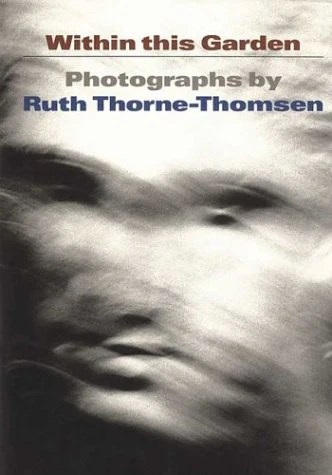
- Within This Garden: Photographs by Ruth Thorne-Thomsen
- Published by The Museum of Contemporary Photography, Columbia College Chicago (1993).
- Includes extensive plates of her photographs, essays (by Denise Miller-Clark), and a poem by Mark Strand.
- Exhibition catalog for Travels to Interior Spaces: The Photographs of Ruth Thorne-Thomsen (Danforth Museum of Art, 1989), with black-and-white plates and exhibition context.


